Monday, September 23, 2013

Gary Kaleda

Kaleda's work, Dialog (2012) from Rhizome
Gary Kaleda is a digital artist from New York.  His formal training was based in traditional art techniques, but with the new forms of technology, his artwork transitioned from multi-media to entirely digital media.  He learned traditional art methods from Pratt University and graduated with honors in 1988 ("Biography").  His first job was working for a company that retouched photographs. Technology began to influence his life, as by 1997 he was a pre-press technician for a New York publication firm, working with Photoshop (c), Illustrator (c), and Painter (c) to photo retouch and color correct images.  These new digital tools led to his mixed media projects, printing his digital images on canvas and using spray paint and other solvents.  By 2001, his artwork became completely digital.  By 2010, he continued adapting to new technology by  making use of QR codes within his pieces.  This technological take-over is also prominent in the context of his work, as he primarily focuses on the "fear, uncertainty, and beauty of the digital age" (Kaleda).

My favorite work of his is Dialog (pictured above), which was created in 2012.  Looking at the image, Kaleda seems to be representing the impersonal communication that technology has created.  Two faces are clearly visible within the work, yet digital glitching is separating the two figures, almost entirely removing the second face in the process.  This reveals that while people use technology to communicate with each other, it creates a distance and distortion within the dialog, something that more traditional and personal forms of communication could prevent.  Digital communication, including texting and instant messaging, remove the emotion out of the conversation, causing us to add our own interpretation into what the other person is feeling, something that could be represented by the lack of facial features on the second character.  The new removal of emotions from dialog causes a disconnect between people, which this work helps visualize.

I love the aesthetic quality of the work, as the realistic faces are extremely detailed to the point that even eyelashes are depicted.  The colors within the work are not realistic of human tones, yet at the same time do not take away from the anatomical figures.  The concept is influential to daily life and the title, "Dialog," is strong enough to depict to the audience a general idea of what is going on within the work, as in current society, many people have experienced the disconnect new forms of communication can inadvertently promote.  The technological glitching is used in a way that enhances the image, as by removing the second figure's face, it makes the point that the artist wanted to make:  that new technology can lead to uncertainty, even within what poses as conversation between people.  The glitching also spreads as far as the first figure's nose and hair, showing the effect that this distortion of communication can have on even the original figure, yet still allowing the audience to fully understand that it is a human face, and therefore realizing that the second figure should also have such a realistic face, yet technology is getting in the way.  The glitching of the image is used so that it does not take away the audience's ability to perceive and understand the work, yet shows the impact that technology has in distorting human communication.  In my opinion, there's not much that Gary Kaleda could have done to make the work stronger.


Works Cited
    "Biography." Gary Kaleda Digital Painting. Gary Kaleda, n.d. Web. 23 Sept. 2013.
    Kaleda, Gary. "Dialog (2012)." Rhizome. N.p., 22 Sept. 2013. Web. 23 Sept. 2013.

Thursday, September 19, 2013

Face Mash Up

+
equals:

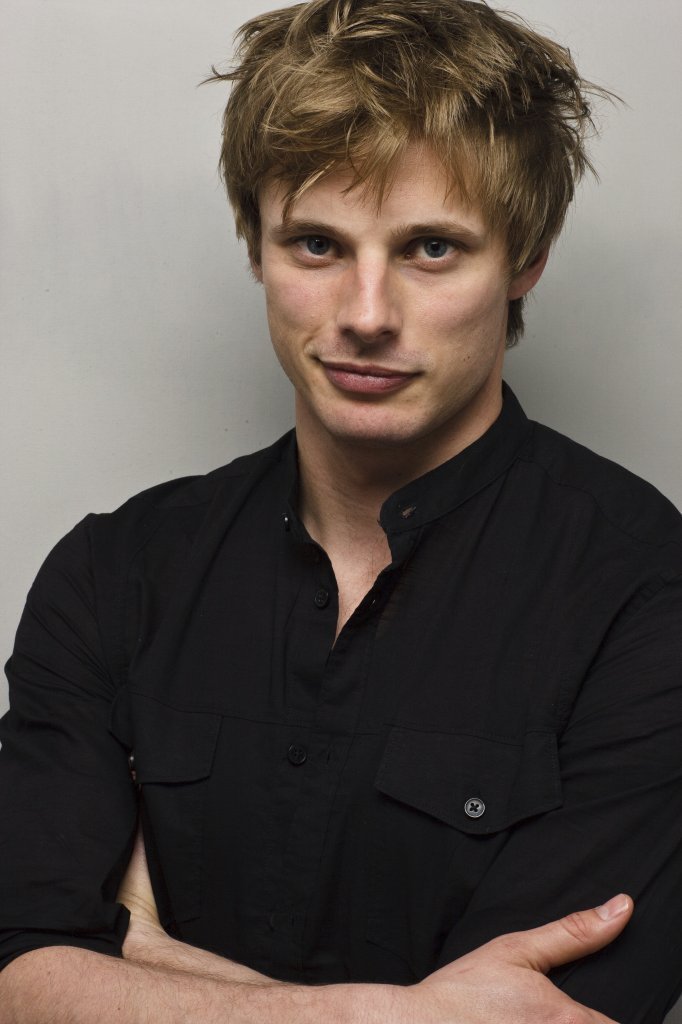
Bradley James with Matt Smith's hair and eyes.

Tuesday, September 17, 2013

Corrected Images


Before and After images

Digital Collage

I saw the lacrosse glove and it reminded me of someone, so I was inspired to create a story in my collage.

Wednesday, September 4, 2013

Andreas Muller-Pohle

Andreas Muller-Pohle is an artist and publisher from Berlin.  He was awarded the Reind M. De Vries’ European Photography Prize in 2001.  He has worked as a professor and written books about photo theory.  His work included within the Christiane Paul text was Blind Genes.  Ten years before he created Blind Genes in 2002, he began experimenting with genetic, digital, and political codes, with this work combining two of them.

Blind Genes is the listed genetic sequence of DNA that is contained within the trait of blindness, where the four nucleotide bases are color coded, before being put into braille.  After the background reading, there is not much left to decipher as an audience.  Braille allows the blind to communicate with other people and this representation of what blindness is scientifically, in braille.  The colors within the work, on the other hand, are only available to the audience with sight, juxtaposing the culture of those without sight and those with sight.  Blind Genes causes the audience to wonder about what it would be like to be blind, reading braille and not seeing the colors in front of them.  

This is a strong piece, simplistic yet it makes a statement.  The only critiques are that without the background information, the piece loses its emphasis, as it may look like random colorized braille. Yet at the same time, knowing the background of the work leaves less interpretation for the audience, since there is no abstractness to the piece itself.  The abstract thoughts therefore, are to be put into the mind of the audience.  

Image from here.