Saturday, December 14, 2013

Art Event: Natalie Jeremijenko

On November 19, Natalie Jeremijenko came to the DPC to promote her art and environmental awareness.  Natalie Jeremijenko is an art professor from NYU that combines art and engineering to create projects that promote environmental awareness.  She founded the Environmental Health Clinic, a place where people can come and express their environmental concerns and develop a locally optimized solution.  The sentiments behind the Environmental Health Clinic were to create an external and shared version of health between people and the environment.

Past projects of Jeremijenko include bird perches that trigger recorded messages when birds land on them.  The messages are symbiotic, telling people to feed and respect the birds.  She has also organized biochard samba parties, where people get together and burn papers to create biochard, which sequesters carbon from the atmosphere.  Among other projects, she has been part of the creation of the butterfly bridge, which helps butterflies follow flower to flower by planting flowers and hooking them to power-line poles.
The Butterfly Bridge, from environmentalhealthclinic.net

My favorite project of hers is the amphibious architecture she created in the rivers of New York City.  This is made up of buoys with sensors that trigger LED lights to turn on when fish swim under them.  This reminds the people in the city that fish actually live in those rivers.  A phone app also allows people to feed the fish through the buoys, which will in turn cause more fish to swim under the buoy sensors.  This is an example of the environmental reciprocity that is Jeremijenko's goal.  She wants people to be able to work together with the environment and the animals within it to benefit both sides.

Amphibeous Architecture, from Animal Architecture. Org

She promotes city farming through agbags and vertical farming on the sides of buildings.  To prevent competition with rural farmers, Jermijenko advertises the uses of flowers in cooking.  By growing flowers in cities, they will be able to filter the air and not raise food prices.  The flower petals are high in nutrients when they are first plucked and can be used in a variety of dishes, including black pansy vodka.

Jermijenko uses her art to advertise her hope that we can save the environment through not radical change, but simple deviations to our normal lifestyle.  She wants to make self-interests of one person into a collective interest of a community.  The Environmental Health Clinic is in communication with other similar organizations throughout the world, and even though they all have different problems, they can use similar experiments that locally make sense yet can develop features that can be shared to other places.  Jermijenko works forward to create in her audience a shared public memory of a possible future, that will come true if we all work together for a reciprocal relationship with nature.

Monday, November 25, 2013

George English Web Design

Dark Gallery, from g30dud3's DeviantArt page

George English is a web designer from the United Kingdom.  Known as g30dud3 on DeviantArt, English posts images of his web layouts.  Not much personal information is shown about him and I am unsure if the designs are actually part of uploaded websites.  He also creates traditional artwork with oil pastel and pencil, focusing primarily on landscapes and nature, such as flowers.  His photography likewise revolves around scenery, either man-made places or natural forms, such as plant life.
DesignCritique Submission, from g30dud3's DeviantArt page
The web designs are visually pleasing and easy to navigate because of their simplicity.  His design, Dark Gallery is simple with four main links to main categories within the site:  Home, About Me, Gallery, and Contact.  The main focus of the website is a single image, probably taken by George English himself, and a textured background.

His other work, DesignCritique Submission, contains more content but still maintains a streamlined appearance.  This is possible through the use of small thumbnails and organized columns of information.  The layout is cut into two main columns, one that is 3/4 of the whole screen, containing the majority of the text.  The smaller column contains the ads, which are organized in a small, square order, and the About and Team information.  The simple banners color block the page, making it visually stimulating without being overwhelming.  The color choices are mostly similar colors, black and two shades of blue, making the smaller examples of pink and orange stand out from the rest of the screen.

With my limited experience with web design, it is hard to comment on what could be executed better.  The designs are successful because of their simplicity while maintaining interest in the viewer.  The first design, Dark Gallery, does so with its gorgeous photography being placed in primary focus.  The second design, which was made for a Design Critique Contest, maintains interest with its color blocking techniques and simplicity itself.  These designs are easy on the eyes and flow well, making them successful.

Sunday, November 24, 2013

Further Website Progress

I added another story to the website.  The overall appearance still needs work.
Interactive Storybook

Wednesday, November 20, 2013

Project 3 Progress

Here is the link to what I have so far of my web design project:
Interactive Storybook

So far, I've connected all the links to the main story.  I started illustrations to add to the story and am also thinking of a second text.  The website itself does not look very interesting yet and that is one of the most important things I need to work on.

Wednesday, November 13, 2013

Art Event: The Beehive Collective

Detail image from Mesoamerica Resiste
from the Beehive Collective website

On November 12, the Beehive Collective came to the Boyden Gallery to speak about their recent work, Mesoamerica Resiste.  The Bee Hive Collective is a group of artists based in Maine that create intricate prints made of didactic imagery, creating modern day visual fables.  Their art depicts cultural and political issues that are paramount in the world today.

In creating these works, the artists use real life examples from people that encountered the depicted issues first hand, traveling to other countries to hear from rural communities.  Mesoamerica Resiste depicts the ongoing colonization of Mesoamerica, from the arrival of Europeans to the corporate take over that is facing them today.  The front of the work is called Plan Mesoamerica, which is a twist on a cartographer's map from when the Europeans were colonizing Mesoamerica.  On the outskirts of the map, where depictions of the rulers of the expanding country would have been depicted, the artists created representational forms for the economic colonizers, such as NAFTA and the World Trade Organization, which is depicted as a Judge with scales of injustice for siding with corporations at the expense of people and communities.

The World Trade Organization, depicted as a Judge
From the Behance page of Nathan Vieland, one of the inkers of the Beehive Collective
 The poster opens up to find another depiction, showing communities as animals fighting against the consumerist expansion.  These images are depictions of some of the many stories that the Beehive Collective recieved when they traveled Mesoamerica, asking the stories of individuals and communities.  Swirling speech scrolls are adapted from Aztec cultural roots, swirling together and flowing throughout the piece, allowing the animals to fight back against the technological forces.  An example of the adaptation of speech scrolls is included within the first detail image.

Some scenes are taken more literally than others, including the scene of the invading army being physically pushed back from a snail.  This was based off of a picture of a woman pushing back the shoulders of a police officer forcing their town to relocate.

Detail of Mesoamerica Resiste,
from Nathan Vieland's Behance page
This work took the Beehive Collective nine years to complete.  It was a collaborative piece entirely drawn and inked by hand before being scanned to create prints, blowing the image up to four times it's original size.  The Collective uses their prints as learning materials and take them with them when visiting schools and other outreach programs.  They enjoy the reproducible quality of their work, as when presenting to an age group too young to fully understand, they let the children color the poster and interact with it in that way.

Their presentation of their work was fascinating and made the audience think about what exactly is "free trade" and what the effects of it were.  Their depiction of activist artwork is captivating and really causes the message to sink in.  At first glance, their art style is overwhelming, but upon closer look, the many details are intriguing and make the audience want to delve into the stories that the pieces tell.  I look forward to seeing the Beehive Collective's future works.

Tuesday, November 5, 2013

Identify Yourself: To Chat

Identify Yourself, an article by Krystal South, delves into the idea of how the internet plays a strong role on personal identity.  South follows her personal interaction with the internet, showing how she grew to become dependent on the constant feedback and connection to it.  As a generation, the majority of us are deeply intertwined in the internet, constantly searching for more information, new ways to interact with others, and new ways to express ourselves.

The section of her article that I found the most engaging was "To Chat," which focuses on how text chat has changed how we think and communicate with others.  We tend to think in ways that we can relate to plain text, wondering how we can make our thoughts a single Facebook status or Tweet.  Online text chats allow us to not only communicate with people that we would not ordinarily talk to in person but also allow us to real life friends in other ways.  Facebook allows me to "talk" to high school friends that have moved hours away to go to college and still feel somewhat connected to their lives and also provides me with a new way to communicate with people that I am physically close to, ranging from normal text to the new Pusheen cats in the chat box.

Image from pusheen.com


Chat also allows us to maintain a control over the conversation that we cannot have in real life.  If you have a conversation with someone in person and they make you upset or angry, they have the opportunity to notice this through your facial features, vocal tones, body language, language delivery, and other physical features.  In an online text chat, emotions are indiscernible, and a single sentence could be interpreted a variety of ways.  This can be both positive and negative to relating to other people, as if you're trying to remain calm, you don't have to reveal emotions that you think will jeopardize the conversation or make your relationship with someone awkward.  There have been several conversations that I have had over text chat because I knew if I said it any other way I would become too emotional and might strain the friendship I had with the person.  Yet at the same time, if you cannot understand someone's emotions, then it can be hard to connect to them, creating an emotional divide between the two of you.   Misunderstandings can also arise, as you might be perfectly calm, yet the other person reads your tone as angry and responds in what they see is appropriate to the situation.  Pure lines of text are highly influenced by the reader's personal emotion and sometimes you can read the same conversation in several different tones purely based on your emotion.  Long distance friendships put a strong emphasis on text chats, as they are much easier than phone calls and video chats, which are slightly more connecting than pure words.  Yet at the same time, chat can leave a person wanting, as these emotional interpretations are tiring and in many ways lesser to hearing the person's voice.  Sometimes though, that desire for control over the conversation, such as the ability to choose your words beforehand and reserving your emotion for only when you want it to obviously show, can make a text chat seem much easier and allow you to connect with someone when otherwise you have no courage to speak with them.  Finding the confidence to flirt may be easier in Facebook chat than in person, but it may also be more indirect and less personal.  The multitasking of the internet allows us to send many people a message at the same time or be reporting the whole conversation to a third party without the other person realizing, something that is difficult to do in face-to-face conversations, so sometimes text chat can seem highly impersonal.

Online chat seems to be a compromise between convenience and communication.  Chat allows a person to connect to many people over the world, yet it is difficult to connect to someone in exactly the same way that you would in person.  My mother, who grew up before these emotionless ways of communicating with others, will be the first person to tell me that important conversations should be face-to-face or at the very least over the phone.  Yet in many situations it simply seems easier to send a message via text or chat, most likely a reflection of our current absorption into internet culture.

Wednesday, October 23, 2013

Man Tsun

"Curioos Olympic Collective" by Man-Tsun
from Behance.net
Man Tsun is a digital artist from Hong Kong.  He studied art in Canada and is currently working as a creative manager, creating corporate art at work and his own personal style in his free time ("Man-Tsun Creates Transparently Beautiful Art").  He is largly influenced by the manga art style, especially by Inoue Takehiko and Sho-u Tajima.  He primarily works with the pen tool in Adobe Illustrator, sometimes turning to Photoshop for his initial sketches and for final blurs on selected areas (Tsun).  He also has experimented with newer materials, even printing one of his exhibits on plastic transparencies, either creating an image with several physical layers or interacting with the environment, as in his prints "Death" and "Birdcage".
"Death" by Man-Tsun, Digital print on transparency x2, 2 ft. by 5.5 ft
from Behance.net 

The two vector prints that make-up "Death"
"Birdcage" by Man-Tsun, Digital print on transparency, 2 ft. by 2 ft.
from Behance.net
His digital prints tend to have crisp lines and a thin range of colors.  The pieces that he creates for work have an advertising feel, like the first Olympic print.  The bright, domineering colors create a sense of power that suits an athlete, especially to be associated with the Olympics.   Vectors make the shadows within the work and gradients within the golden swirling designs around the figure.  This swirling design and the lines extending off the back leg create a feeling of movement, enhanced by the foreshortening in his front arm and leg.
The transparency images appear to be created in Man-Tsun's personal style, with their darker tones than that of his bright athletic print.  The colors in "Death" are much more muted, partially because of the fact that the print is two layered.  The colors within the two prints match, focusing on black and shades of purple, along with empty space.  The twin layers create an interesting effect, acting as both cause-and-effect and a simultaneous image.  Tsun describes the story as a guitarist that gets eaten by a deadly garden and its butterflies, with the images first showing the man in the garden and then his skeleton after he has died ("Man-Tsun Creates Transparently Beautiful Art").  The presentation of the prints creates this story in one glance, blurring the cause and effect together into one instant when the viewer looks at it.  This creates a foreboding image, especially when combined with the work's title.
"Birdcage" contains slightly more colors and is only printed on one transparency.  The lines are stark against the natural flesh and hair tones of the image.  Even though the work is only one physical layer, the material it is printed on allows it to interact with its surroundings, as it hangs from the ceiling of a bookshop, allowing customers to walk behind it, putting their own face within the cage.  This interaction adds to the print, as it is more than just an impersonal piece hanging on the wall.  Vector shapes create the shading on the cheeks and the hair.

All three of his above works are very strong, as they are dynamic with the precise lines and his choice of colors.  His traditional print appears powerful because of the figure's pose and the bright pop colors that Man-Tsun used.  The second work listed, "Death," is dynamic in its cold colors and the otherwise absence of color.  The transparent three dimensional butterflies around the piece help tell its story and tie in the rest of the collection by being interspersed within the room.  The two competing prints create an interesting effect, even if at first glance the story can be a bit difficult and overwhelming to read.  The interaction within the layers creates a stronger effect than when the two images are simply displayed beside each other.  "Birdcage" is also strong because of its stark contrast between organic and man-made.  The horizontal split of the figure's face is visually interesting and aesthetically pleasing.  The two halves of her face juxtapose each other, yet remain balanced, just like the natural tones within her face equalize the inorganic wires of the birdcage.  The interactive aspect of the work adds to the intriguing visual qualities of the print and would make the audience more likely to study it.  Each work is strong on its own and I see little room for enhancement that the artist could have done.

Works Cited
Tsun, Man. "Case Study: District with You & Me by Man-Tsun." Vectips. N.p., 14 Feb. 2011. Web. 23 Oct. 2013.
"Man-Tsun Creates Transparently Beautiful Art." Digital Arts Online. N.p., 13 Oct. 2011. Web. 23 Oct. 2013.
Tsun, Man. "Illustration X Transparency." Behance. N.p., 18 Oct. 2011. Web. 23 Oct. 2013.
Tsun, Man. "Illustration 6." Behance. N.p., 28 Jan. 2013. Web. 23 Oct. 2013.
Tsun, Man. "Manxtsun.com." Manxtsun.com. N.p., n.d. Web. 23 Oct. 2013.

Saturday, October 19, 2013

Further Portrait Progress


text remix

I kept the quotes the same for the most part and changed from a watch image to a simpler clock face.  The image might be too simple but its easier to look at this way.

Tuesday, October 8, 2013

line art

My first experience with Adobe Illustrator:  turning this
to this:


Monday, October 7, 2013

Charles A. Csuri

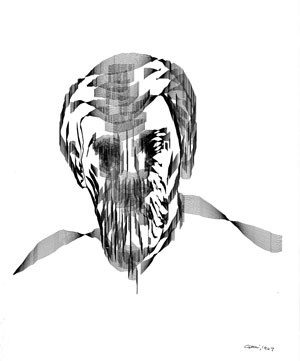
Sine Curve Man, Charles A. Csuri with James Shaffer, 1967
pictured within the Paul Hertz reading
Charles Csuri was an art major at Ohio State before graduating and later becoming a professor at the same university (Langberg).  In 1964, Csuri became curious about the computer and by 1965 he began creating films with computer punch cards.  In 1967, he was awarded Brussels's 4th International Experimental Film Festival's animation award (Palazzi).  He has presented his artwork in Sweden, England, France, Spain, Holland, Italy, and Japan.  He directed research in computer graphics for over 22 years, funded by the National Science Foundation, the Navy, and the Air Force Office of Scientific Research in order to create 15 major projects. He was the first artist to ever be funded by the NSF. This research involved 40 computer science students and at least 50 art students.  Csuri has been awarded Ohio State's highest honor, the Joseph Sullivant medal for being a faculty member with a strong impact on society (Palazzi).  His early digital works defined the common themes still used within his work, including object transformation and levels of control (Glowski).

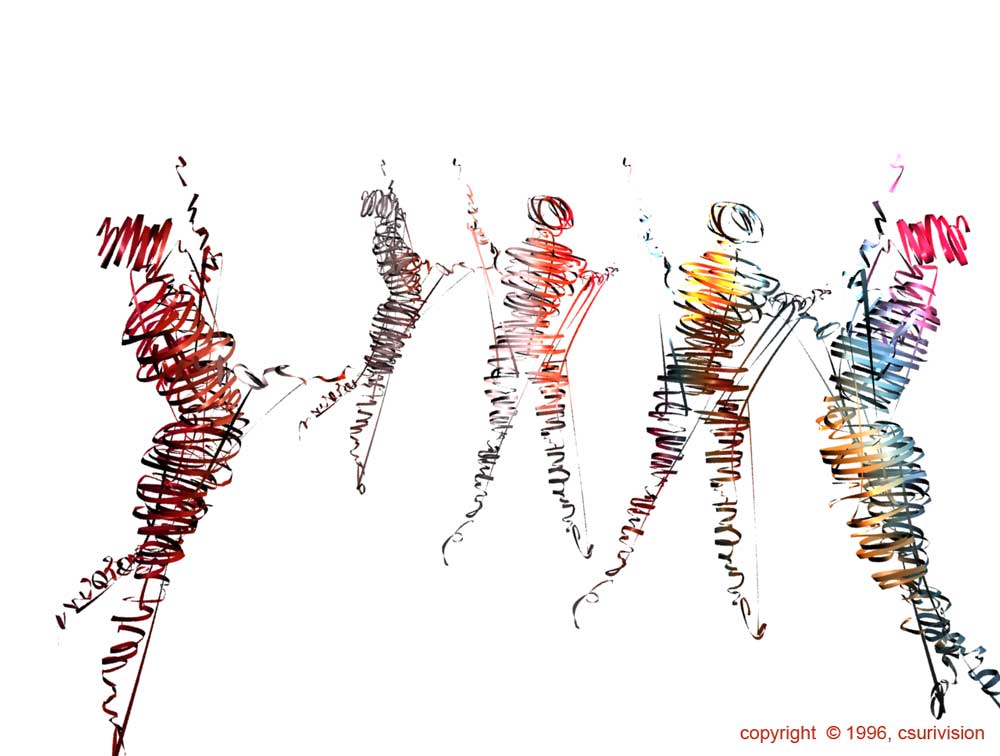
His work included within the class reading is Sine Curve Man, which was created with the help of James Shaffer.  Together they created the software to create it on the IBM 7094 (Hertz).  The work seems to reveal the mathematical processes within everyday life, creating the image of a man using only digital technology in 1967.  This work could also represent that technology is morphing the human elements of life, distorting them away from their natural lines.  The lack of color in this work intensifies the inhuman aspects of it, alluding to the binary codes of technology.  His more recent works utilize colors in often outlandish ways, such as in A Happy Time, pictured below.  The lack of color in Sine Curve Man makes the composition simpler but also creates a strong distinction in where the lines are, emphasizing that the work's composition is entirely full of sine curves.  The main quality of Sine Curve Man is that the work is made up of those curves that distort the original human face.

A Happy Time, Charles A. Csuri, 1997
found on CsuriVision


I believe that Sine Curve Man is a strong work.  It grabs the audience's attention because many qualities obviously look like a face, but the distortion seems odd to the viewer.  The lack of color may have been due to technological short comings, as during the time that the work was created, Csuri and Shaffer would have had to rely on punch cards to create it.  Despite where the use of only black and white may have come, the binary quality works in the advantage of Csuri, as the dynamism makes the work easier to read and more noteworthy.  More colors would most likely make the work more difficult to read, especially around the figure's nose.

Works Cited
Csuri, Charles A. "Lines in Space, 1996." CsuriVision. N.p., 21 Feb. 2013. Web. 07 Oct. 2013.
Glowski, Janice M. "Csuri Project: Featured Collection." The Ohio State University. N.p., 2007. Web. 06 Oct. 2013.
Langberg, Ben. "Introduction." Charles Csuri. N.p., n.d. Web. 06 Oct. 2013.
Palazzi, Maria. "Charles A. Csuri Project." The Ohio State University. N.p., 2007. Web. 06 Oct. 2013.

Monday, September 23, 2013

Gary Kaleda

Kaleda's work, Dialog (2012) from Rhizome
Gary Kaleda is a digital artist from New York.  His formal training was based in traditional art techniques, but with the new forms of technology, his artwork transitioned from multi-media to entirely digital media.  He learned traditional art methods from Pratt University and graduated with honors in 1988 ("Biography").  His first job was working for a company that retouched photographs. Technology began to influence his life, as by 1997 he was a pre-press technician for a New York publication firm, working with Photoshop (c), Illustrator (c), and Painter (c) to photo retouch and color correct images.  These new digital tools led to his mixed media projects, printing his digital images on canvas and using spray paint and other solvents.  By 2001, his artwork became completely digital.  By 2010, he continued adapting to new technology by  making use of QR codes within his pieces.  This technological take-over is also prominent in the context of his work, as he primarily focuses on the "fear, uncertainty, and beauty of the digital age" (Kaleda).

My favorite work of his is Dialog (pictured above), which was created in 2012.  Looking at the image, Kaleda seems to be representing the impersonal communication that technology has created.  Two faces are clearly visible within the work, yet digital glitching is separating the two figures, almost entirely removing the second face in the process.  This reveals that while people use technology to communicate with each other, it creates a distance and distortion within the dialog, something that more traditional and personal forms of communication could prevent.  Digital communication, including texting and instant messaging, remove the emotion out of the conversation, causing us to add our own interpretation into what the other person is feeling, something that could be represented by the lack of facial features on the second character.  The new removal of emotions from dialog causes a disconnect between people, which this work helps visualize.

I love the aesthetic quality of the work, as the realistic faces are extremely detailed to the point that even eyelashes are depicted.  The colors within the work are not realistic of human tones, yet at the same time do not take away from the anatomical figures.  The concept is influential to daily life and the title, "Dialog," is strong enough to depict to the audience a general idea of what is going on within the work, as in current society, many people have experienced the disconnect new forms of communication can inadvertently promote.  The technological glitching is used in a way that enhances the image, as by removing the second figure's face, it makes the point that the artist wanted to make:  that new technology can lead to uncertainty, even within what poses as conversation between people.  The glitching also spreads as far as the first figure's nose and hair, showing the effect that this distortion of communication can have on even the original figure, yet still allowing the audience to fully understand that it is a human face, and therefore realizing that the second figure should also have such a realistic face, yet technology is getting in the way.  The glitching of the image is used so that it does not take away the audience's ability to perceive and understand the work, yet shows the impact that technology has in distorting human communication.  In my opinion, there's not much that Gary Kaleda could have done to make the work stronger.


Works Cited
    "Biography." Gary Kaleda Digital Painting. Gary Kaleda, n.d. Web. 23 Sept. 2013.
    Kaleda, Gary. "Dialog (2012)." Rhizome. N.p., 22 Sept. 2013. Web. 23 Sept. 2013.

Thursday, September 19, 2013

Face Mash Up

+
equals:

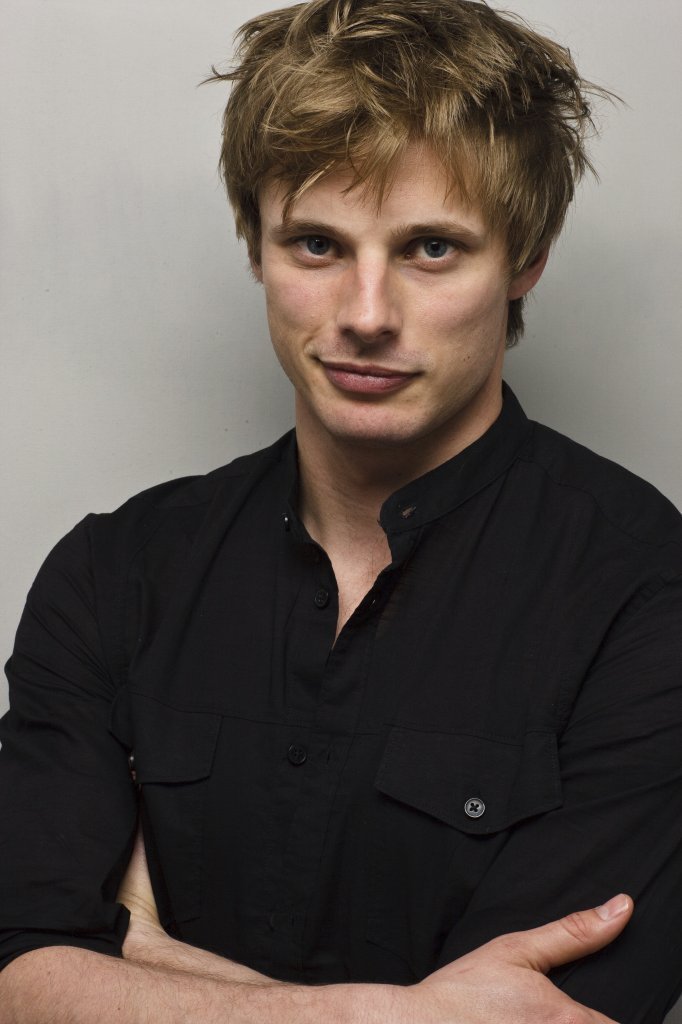
Bradley James with Matt Smith's hair and eyes.

Tuesday, September 17, 2013

Corrected Images


Before and After images

Digital Collage

I saw the lacrosse glove and it reminded me of someone, so I was inspired to create a story in my collage.

Tuesday, September 10, 2013

Ten Scans


The last one is my favorite and is a scan of a sketch in progress.