
Wednesday, October 30, 2013

Wednesday, October 23, 2013
Man Tsun
 |
| "Curioos Olympic Collective" by Man-Tsun from Behance.net |
Man Tsun is a digital artist from Hong Kong. He studied art in Canada and is currently working as a creative manager, creating corporate art at work and his own personal style in his free time ("Man-Tsun Creates Transparently Beautiful Art"). He is largly influenced by the manga art style, especially by Inoue Takehiko and Sho-u Tajima. He primarily works with the pen tool in Adobe Illustrator, sometimes turning to Photoshop for his initial sketches and for final blurs on selected areas (Tsun). He also has experimented with newer materials, even printing one of his exhibits on plastic transparencies, either creating an image with several physical layers or interacting with the environment, as in his prints "Death" and "Birdcage".
 |
| "Death" by Man-Tsun, Digital print on transparency x2, 2 ft. by 5.5 ft from Behance.net |
 |
| The two vector prints that make-up "Death" |
 |
| "Birdcage" by Man-Tsun, Digital print on transparency, 2 ft. by 2 ft. from Behance.net |
The transparency images appear to be created in Man-Tsun's personal style, with their darker tones than that of his bright athletic print. The colors in "Death" are much more muted, partially because of the fact that the print is two layered. The colors within the two prints match, focusing on black and shades of purple, along with empty space. The twin layers create an interesting effect, acting as both cause-and-effect and a simultaneous image. Tsun describes the story as a guitarist that gets eaten by a deadly garden and its butterflies, with the images first showing the man in the garden and then his skeleton after he has died ("Man-Tsun Creates Transparently Beautiful Art"). The presentation of the prints creates this story in one glance, blurring the cause and effect together into one instant when the viewer looks at it. This creates a foreboding image, especially when combined with the work's title.
"Birdcage" contains slightly more colors and is only printed on one transparency. The lines are stark against the natural flesh and hair tones of the image. Even though the work is only one physical layer, the material it is printed on allows it to interact with its surroundings, as it hangs from the ceiling of a bookshop, allowing customers to walk behind it, putting their own face within the cage. This interaction adds to the print, as it is more than just an impersonal piece hanging on the wall. Vector shapes create the shading on the cheeks and the hair.
All three of his above works are very strong, as they are dynamic with the precise lines and his choice of colors. His traditional print appears powerful because of the figure's pose and the bright pop colors that Man-Tsun used. The second work listed, "Death," is dynamic in its cold colors and the otherwise absence of color. The transparent three dimensional butterflies around the piece help tell its story and tie in the rest of the collection by being interspersed within the room. The two competing prints create an interesting effect, even if at first glance the story can be a bit difficult and overwhelming to read. The interaction within the layers creates a stronger effect than when the two images are simply displayed beside each other. "Birdcage" is also strong because of its stark contrast between organic and man-made. The horizontal split of the figure's face is visually interesting and aesthetically pleasing. The two halves of her face juxtapose each other, yet remain balanced, just like the natural tones within her face equalize the inorganic wires of the birdcage. The interactive aspect of the work adds to the intriguing visual qualities of the print and would make the audience more likely to study it. Each work is strong on its own and I see little room for enhancement that the artist could have done.
Works Cited
Tsun, Man. "Case Study: District with You & Me by Man-Tsun." Vectips. N.p., 14 Feb. 2011. Web. 23 Oct. 2013.
"Man-Tsun Creates Transparently Beautiful Art." Digital Arts Online. N.p., 13 Oct. 2011. Web. 23 Oct. 2013.
Tsun, Man. "Illustration X Transparency." Behance. N.p., 18 Oct. 2011. Web. 23 Oct. 2013.
Tsun, Man. "Illustration 6." Behance. N.p., 28 Jan. 2013. Web. 23 Oct. 2013.
Tsun, Man. "Manxtsun.com." Manxtsun.com. N.p., n.d. Web. 23 Oct. 2013.
Saturday, October 19, 2013

text remix

Wednesday, October 16, 2013

Thursday, October 10, 2013

Wednesday, October 9, 2013


Tuesday, October 8, 2013


Monday, October 7, 2013
Charles A. Csuri
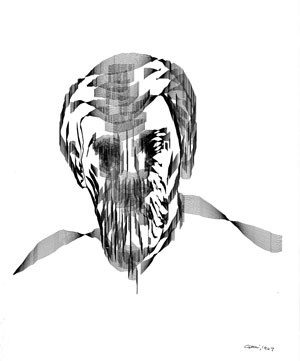 |
| Sine Curve Man, Charles A. Csuri with James Shaffer, 1967 pictured within the Paul Hertz reading |
His work included within the class reading is Sine Curve Man, which was created with the help of James Shaffer. Together they created the software to create it on the IBM 7094 (Hertz). The work seems to reveal the mathematical processes within everyday life, creating the image of a man using only digital technology in 1967. This work could also represent that technology is morphing the human elements of life, distorting them away from their natural lines. The lack of color in this work intensifies the inhuman aspects of it, alluding to the binary codes of technology. His more recent works utilize colors in often outlandish ways, such as in A Happy Time, pictured below. The lack of color in Sine Curve Man makes the composition simpler but also creates a strong distinction in where the lines are, emphasizing that the work's composition is entirely full of sine curves. The main quality of Sine Curve Man is that the work is made up of those curves that distort the original human face.
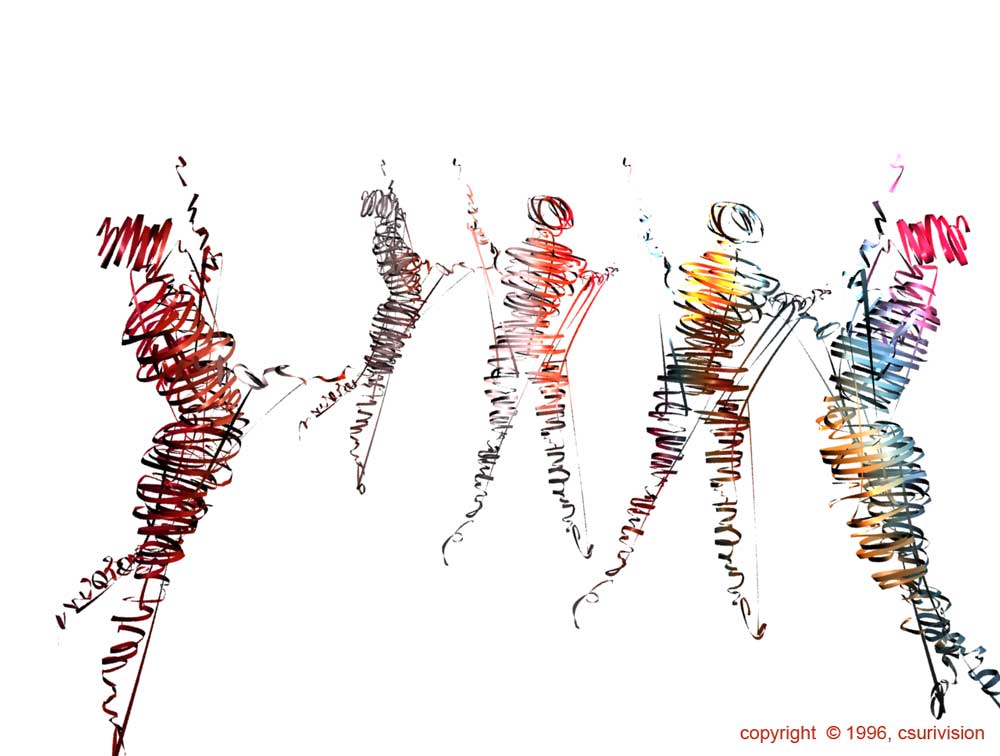 |
| A Happy Time, Charles A. Csuri, 1997 found on CsuriVision |
I believe that Sine Curve Man is a strong work. It grabs the audience's attention because many qualities obviously look like a face, but the distortion seems odd to the viewer. The lack of color may have been due to technological short comings, as during the time that the work was created, Csuri and Shaffer would have had to rely on punch cards to create it. Despite where the use of only black and white may have come, the binary quality works in the advantage of Csuri, as the dynamism makes the work easier to read and more noteworthy. More colors would most likely make the work more difficult to read, especially around the figure's nose.
Works Cited
Csuri, Charles A. "Lines in Space, 1996." CsuriVision. N.p., 21 Feb. 2013. Web. 07 Oct. 2013.
Glowski, Janice M. "Csuri Project: Featured Collection." The Ohio State University. N.p., 2007. Web. 06 Oct. 2013.
Langberg, Ben. "Introduction." Charles Csuri. N.p., n.d. Web. 06 Oct. 2013.
Palazzi, Maria. "Charles A. Csuri Project." The Ohio State University. N.p., 2007. Web. 06 Oct. 2013.
Subscribe to:
Comments (Atom)