 |
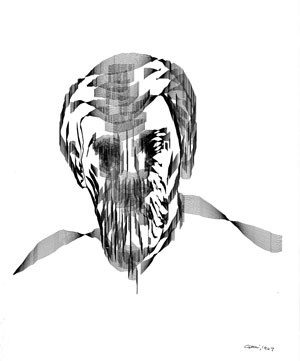
| Sine Curve Man, Charles A. Csuri with James Shaffer, 1967 pictured within the Paul Hertz reading |
His work included within the class reading is Sine Curve Man, which was created with the help of James Shaffer. Together they created the software to create it on the IBM 7094 (Hertz). The work seems to reveal the mathematical processes within everyday life, creating the image of a man using only digital technology in 1967. This work could also represent that technology is morphing the human elements of life, distorting them away from their natural lines. The lack of color in this work intensifies the inhuman aspects of it, alluding to the binary codes of technology. His more recent works utilize colors in often outlandish ways, such as in A Happy Time, pictured below. The lack of color in Sine Curve Man makes the composition simpler but also creates a strong distinction in where the lines are, emphasizing that the work's composition is entirely full of sine curves. The main quality of Sine Curve Man is that the work is made up of those curves that distort the original human face.
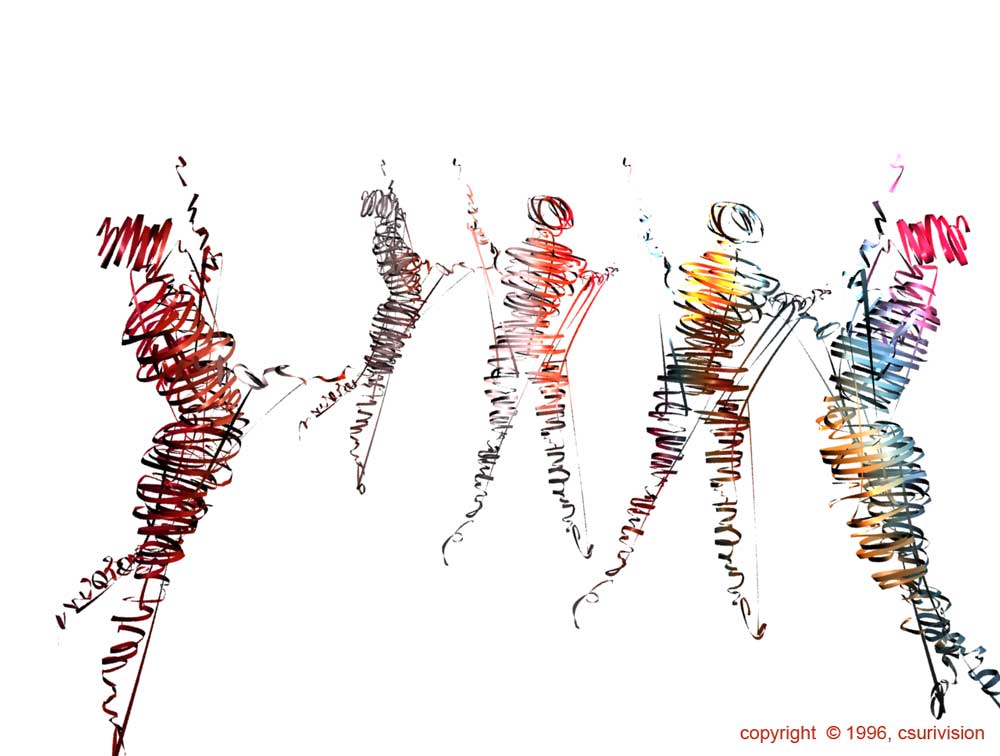 |
| A Happy Time, Charles A. Csuri, 1997 found on CsuriVision |
I believe that Sine Curve Man is a strong work. It grabs the audience's attention because many qualities obviously look like a face, but the distortion seems odd to the viewer. The lack of color may have been due to technological short comings, as during the time that the work was created, Csuri and Shaffer would have had to rely on punch cards to create it. Despite where the use of only black and white may have come, the binary quality works in the advantage of Csuri, as the dynamism makes the work easier to read and more noteworthy. More colors would most likely make the work more difficult to read, especially around the figure's nose.
Works Cited
Csuri, Charles A. "Lines in Space, 1996." CsuriVision. N.p., 21 Feb. 2013. Web. 07 Oct. 2013.
Glowski, Janice M. "Csuri Project: Featured Collection." The Ohio State University. N.p., 2007. Web. 06 Oct. 2013.
Langberg, Ben. "Introduction." Charles Csuri. N.p., n.d. Web. 06 Oct. 2013.
Palazzi, Maria. "Charles A. Csuri Project." The Ohio State University. N.p., 2007. Web. 06 Oct. 2013.

No comments:
Post a Comment